
Chess Courses Online: Choose the Right Course for Your Level
Find the right chess course quickly based on your level, playing style, and the areas you most want to improve. Compare beginner foundations, tactics training, essential skills, opening principles, middlegame plans, endgames, attacking play, defensive technique, and complete opening repertoires in one place. Start with the course library below to identify your best next step, then use the FAQs further down to avoid common study mistakes and build a clear, practical improvement plan.
🔥 All courses now 60%–78% OFF
Limited-time offer! – 18 days left
🚨 Support Kingscrusher: How to use your Coupon
To support Kingscrusher & Chessworld directly and secure Lifetime Access, please avoid the "Subscription" default. On the Udemy page, look for the section shown below and select the 🔘 "Buy individual course" radio button before clicking Enroll.
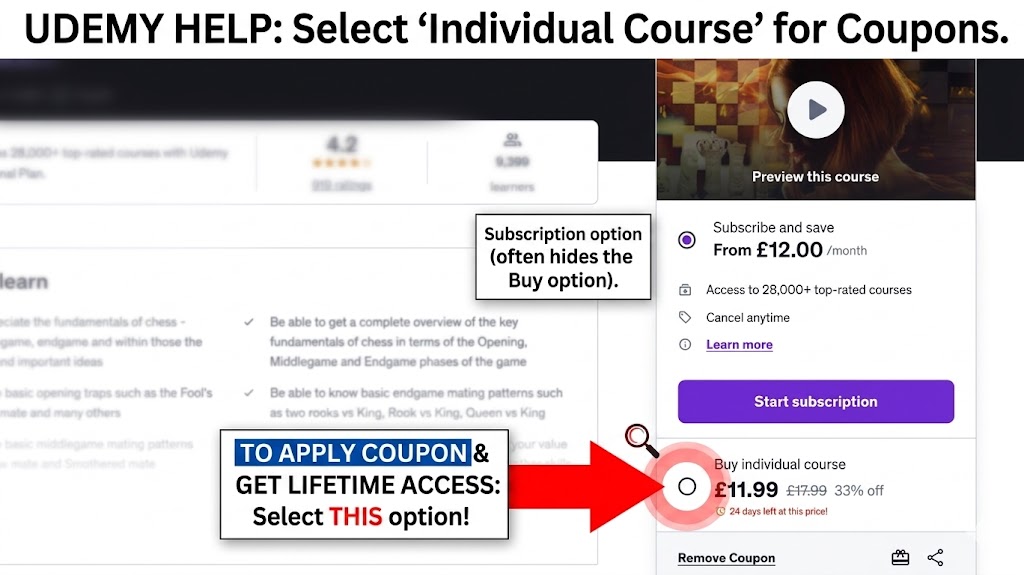
Note: Subscriptions only pay a tiny fraction to instructors; individual purchases allow us to keep creating high-quality chess content.

The Complete Guide to Chess: From Beginner to 1600 ELO
Master openings, middlegame tactics, and endgames in a comprehensive 40-hour step-by-step chess masterclass.

The Complete Guide to Chess Tactics
Chess Tactics, Calculation and Pattern recognition skills that will enable you create beautiful winning combinations

Nimzo-Indian: A Complete Chess Opening Repertoire vs. 1.d4 (New!)
Master the Nimzo-Indian with model games, tactics, strategy, pawn structures, positional play and attacking ideas.

The Complete Guide to Chess Creativity (New!)
David Bronstein chess creativity: candidate ideas, sacrifices, imbalances, king attacks and practical decision-making

The Complete Chess Strategy Course: Master Universal Style (New!)
Learn Universal Chess Strategy with Carlsen-Inspired Hats for Positional Play, Tactical Precision, and Fast Improvement

The Complete Guide to Winning Chess Middlegame Plans (New!)
Master Botvinnik’s proactive Chess planning system – build winning plans instead of drifting or only reacting to threats

The Complete Guide to Essential Chess Skills (New!)
Win More Games with Essential Chess Skills: Openings, Tactics, Calculation, Strategy, Attacking & Positional Play

The Complete Guide to Chess Combination Tactics: British Champions (New!)
Learn powerful tactics, calculation skills, and attacking play from brilliant combinations by British Champions — patterns you can use in every game.

Complete Fun & Easy Chess Repertoire for Beginners (0-1600) (New!)
Learn a complete 1.e4 Chess Opening repertoire: Fun & easy, with traps, plans, and strong replies to all Black defenses

The Complete Guide to Chess Opening Principles (New!)
Master Chess Opening Principles – Improve King Safety, Central Control, Development & Practical Understanding (0–1600)

The Complete Guide to Winning Chess Sacrifice Tactics (New!)
Master Chess Sacrifices and Tactical Brilliance: Learn When to Sacrifice, Spot Key Signals, and Unleash Winning Combos

Chess Opening Weapon: Crush your opponents with the Ponziani (New!)
Chess Opening Weapon: Catch Opponents Off Guard with Tactical Traps– Win Fast with the Ponziani Opening, full of Tactics

Punish Early Opening Mistakes: Tactical Traps & Fast Wins (New!)
Crush Opponents with Chess Opening Traps & Tactics: Must-Know Traps to punish Early Opening Mistakes for fast wins

The Complete Guide to Winning Chess Combination Tactics (New!)
Learn Winning Chess Combination Tactics: Examples from all World Chess Champions from Steinitz to Carlsen and others

The Complete Guide to Defense and Counterattack in Chess (New!)
Master Defense and Counterattack Strategies: Learn Korchnoi’s Techniques in Defense, Counterplay, and Psychology

Supercharge Your Chess With the Italian Game Opening (New!)
Master the Italian Game: Opening Principles, Tactics, Middlegame Strategies, and Key Grandmaster Insights

The Complete Guide to Chess Endgames (New!)
Master Essential Endgame Techniques and Uncover the Beauty of Chess with Iconic Examples from Legendary Players

Supercharge Your Attacking Chess with the King's Gambit (New!)
Master Tactical Themes, Bold Sacrifices, and Devastating Winning Attacks in the Bishop's Gambit

Chess Strategy and Tactics: Steinitz, Father of Modern Chess (New!)
Mastering Chess Strategy: From Dynamic Gambits to Positional Mastery with Steinitz's Game Analysis and Historical Impact

The Complete Guide to Forward-Moving Chess (New!)
Master Brilliant Forward-Moving Chess: Rashid Nezhmetdinov's Key Games, Tactics and Combinations

Supercharge Your Chess Tactics by Punishing Mistakes (New!)
Unlock Alekhine's Secrets: Master Advanced Chess Tactics and Mistake Exploitation with a World Champion’s Strategies

The Complete Guide to Winning Chess using Simple Openings (New!)
Winning Chess: Master Safe Opening Transitions, Middlegame Tactics, Strategy and Endgames with Mir Sultan Khan's games

Chess Strategy, Openings, Tactics: Iconic Hypermodern Games
Learn Hypermodern Chess: Iconic Games, Openings, Central Control, Prophylaxis, Overprotection, and Dynamic Tactics.

A Fun Lovers Guide to the Major Chess Gambits
Explore Openings, Tactics, Initiative, Dynamic Play, Strategic Advantages, and Creative Approaches in Gambit Chess

The Complete Guide to Chess Calculation and Evaluation
Mastering Chess Calculation: Reinforce your Chess Tactics and Strategy through effective Calculation processes

Kings-Indian: A Complete Chess Opening Repertoire vs 1.d4
Boost Your Chess Tactics, Positional Play, and Opening Advantage with King's Indian Defense vs 1. d4 or 1. c4 or 1. Nf3

The Complete Guide to Chess Visualization
Master Your Mental Chessboard: Clear Visualization for Enhanced Strategy, Decision Making, and Game Analysis

Revolutionize Your Chess Game: Learn With AI Neural Networks
Empower Your Chess with Artificial Intelligence(AI): Master Advanced Tactics, Strategy, Evaluations, Pattern Recognition

The Complete Guide to Chess Principles
Learn Chess Principles to Navigate Well: Openings, Middlegame, Strategy, Tactics, Endgames, Art of War and Psychology
The Complete Guide to Chess Strategies
Create effective game strategies based on the elements of the position to help guide your overall game plans

Caro-Kann: A Complete Chess Opening Repertoire vs. 1.e4
Learn the Solid but Dynamic Caro-Kann Defence: Boost Strategies, Tactics, Important Plans and Key Positions vs. 1.e4

The Complete Guide to Positional Chess
Learn Positional Chess: Keeping Control, Small Gradual Improvements, Manage Imbalances, Pawn Structures and Endgames
The Surprise Vienna Game Chess Opening: Tactics and Strategy
A surprise system after 1. e4 e5 2. Nc3 which reduces need to learn lots of theory for the Spanish Game (Ruy Lopez)

The Complete Guide to Attacking Chess
Elements and Ingredients of Winning Attacking Chess Strategies and Tactics. Checkmate ends the game.

The Queen's Knight Attack Chess Opening System (1. Nc3)
Take the opponent by surprise - play 1. Nc3 and win against anything the opponent does

The Complete Guide to Winning Chess with Checkmate Patterns
Winning Chess with Checkmate Patterns: Tactical Traps, Mating Nets, Signals & Thematic Grandmaster Finishes Explained
José Raúl Capablanca: Most instructive chess games 1919-1928
Chess Strategy and Tactics of arguably one of the strongest and most talented natural players of all time

José Raúl Capablanca: Most instructive chess games 1901-1918
Chess Strategy and Tactics of arguably one of the strongest and most talented natural players of all time

The King's Indian Attack Chess Opening: Tactics and Strategy
Learn the King's Indian Attack Opening System: Chess Tactics, Strategy, Positional Play, and Dynamic Attacking Chess
The Sicilian Defence Chess Opening: Tactics and Strategy
Learn About the Sicilian Defence: Explore Strategy, Tactics and Variations Tailored to Your Style and Improvement Goals
Nimzo–Larsen Attack Chess Opening: Tactics and Strategy
Learn the Nimzo-Larsen Attack: Exploring 1.b3 Tactics, Hypermodern Positional Strategies and Plans against any replies
Chess Strategy and Tactics: Emanuel Lasker's Amazing Games
Emanuel Lasker's most instructive games of Chess 1889-1899 - The Longest reigning World Chess Champion for 27 years

Crush the Sicilian Defence Chess Opening: Smith-Morra Gambit
Win against the Sicilian Defence using the Smith-Morra Gambit and master Attacking Chess and Tactics in the process

Chess Strategy and Tactics:Tigran Petrosian's amazing games
Learn important strategies and tactics from Tigran Petrosian aka 'Iron Tigran' - the 9th World Chess Champion

Chess Strategy and Tactics:Mikhail Tal's amazing games
Masterpieces of Strategy and Tactics which can be appreciated by studying the amazing games of Mikhail Tal

Chess Strategy and Tactics: Paul Morphy's amazing games
Learn important strategies and tactics from the genius of Paul Morphy - the unofficial world chess champion of his day

Crush the Caro-Kann Chess Opening: Tactics, Tricks and Traps
Learn How to Crush the Caro-Kann Defense: Surprise Moves, Strategies, Cunning Traps and Tactics to Secure Your Victory
Crush The French Defense Chess Opening: Traps and Tactics
Learn How To Crush the French Defence: Key Game Lessons with Tactics, Tricks, Traps, and Well Proven Winning Strategies

Kingscrusher's Chess Tactics Training - Volume 1
Train your ability to calculate, visualise and evaluate chess positions
The Solid London System Chess Opening: Tactics and Strategy
Be able to play 1.d4 and win against anything your opponent does

The Provocative Tango Chess Opening: Tactics and Strategy
Learn The Provocative Black Knights Tango: Provocative Strategies to Win Tactically vs. both 1.e4 and 1.d4 Openings

The Ultimate Guide to Chess Pawn Structures
Master the essential pawn structures with instructive examples from the World chess champions

A fun lovers Guide to the Major Chess Openings (Udemy HIGHEST RATED)
Find chess openings that are right for your personality, goals and interests and chess improvement needs generally
Bobby Fischer's most instructive games of Chess 1956-1962
Learn about Bobby Fischer's Opening repertoire, tactics and common strategies from this period of Fischer's career
Bobby Fischer's most instructive games of Chess 1963-1968
Masterpieces of Tactics and Strategy from American Chess Legend Bobby Fischer

Bobby Fischer's most instructive games of Chess 1970-1992
Bobby Fischer successfully takes on the entire Soviet Chess Machine and became World Chess Champion in 1972
Questions answered on this page
- Which course should a complete beginner take?
- Which chess course fits my level and weakness?
- Can I build a weekly course study plan?
- Where is the beginner masterclass?
- Which course helps with tactics and blunders?
- Which course helps with middlegame planning?
- Which course teaches opening principles?
- Which course teaches endgames?
- Which course teaches positional chess?
- Which course teaches attacking chess?
- Where can I preview the teaching style?
- How do I get the most value from a course?
Chess Course Selection Adviser
Choose your level, biggest weakness, preferred style and weekly time. The adviser recommends one primary course, one supporting course and a concrete starting action.
Interactive Weekly Course Study Plan
Choose a weekly time budget, number of study days and whether you want a supporting tactics session. The builder creates a practical plan and tracks each completed step.
0 plan steps complete
🧭 Learn More Before Choosing a Course
Not sure where to start? These short guides help you understand how the courses work, what you’ll gain, and which direction fits your goals.
- How Kingscrusher’s Chess Courses Are Structured Learn how the courses progress from beginner to advanced, and how to choose the right one.
- Watch Chess Course Trailers & Previews Preview the teaching style and format before committing.
- Chess Course FAQs & Benefits Common questions answered, plus what you gain from learning chess online.
- Tryfon Gavriel on Udemy: Instructor Profile & Credibility Why Kingscrusher is one of Udemy’s most trusted chess instructors, with thousands of students and reviews.
Online Chess Courses FAQ
These answers cover the most common questions about choosing the right chess course, learning online, and deciding where to start.
Getting started
Are these chess courses suitable for beginners?
Yes. Several courses are built for complete beginners and improving club players, including the beginner course and other titles aimed at players rated roughly 0 to 1500. That broad entry path matters because many players need a clear first step instead of a random lesson list. Use the course library above to start with the beginner course, then add tactics once you feel comfortable with the basics.
What is the best first chess course for a complete beginner?
The best first course for a complete beginner is usually The Complete Guide to Chess for Beginners (Rated 0 to 1500). That matters because a true beginner improves faster with core rules, patterns, and simple plans before anything advanced. Start with the beginner course above, then move into the tactics course once you want to win more games quickly.
What rating level are these chess courses best for?
Most of these courses are best suited to beginners, improvers, and club players, especially from beginner level up to around 1600, though some go deeper into strategy and advanced themes. That range matters because most players need both quick improvement and long-term understanding. Use the course library above to match your current level and pick one course that fits your strength right now.
Can intermediate players still benefit from these courses?
Yes. Intermediate players benefit from courses on calculation, planning, positional play, defence, and endgames rather than just basics. That is important because many players plateau due to one missing skill rather than overall weakness. Use the course library above to identify your weakest area and choose a course focused on that specific skill.
Are these courses good for adults as well as younger players?
Yes. These courses are designed for adult learners as well as younger players, with structured explanations and practical examples rather than simplified teaching. That matters because adults usually want clarity and efficiency rather than repetition. Use the course library above to compare course depth and choose one that matches how seriously you want to study.
Can I study these chess courses at my own pace?
Yes. These are on-demand courses, so you can study at your own pace and revisit lessons whenever needed. That flexibility matters because improvement often requires revisiting key ideas multiple times. Use the course library above to compare course length and pick one that fits your available study time.
Do I need to follow the courses in a strict order?
No. You do not need to follow a strict master order, but starting with fundamentals and tactics usually gives the fastest improvement. That progression matters because advanced ideas are much harder to use without basic patterns. Start with a foundation course above, then add a second course once you identify your next weakness.
Is there a recommended order for these chess courses?
Yes. A practical order is beginner fundamentals, then tactics, opening principles, strategy, and finally specialised topics. That sequence matters because tactics and core habits influence almost every game. Use the course library above to build a simple path starting with one core course and one support course.
How many courses should I take at the same time?
Most players benefit from taking one main course and optionally one supporting course such as tactics. That matters because too many courses at once can dilute focus and slow progress. Use the course library above to choose one primary course first, then add another only if you can keep consistent study.
What is the simplest way to get started right now?
The simplest way is to choose one beginner-friendly or broad course and begin immediately rather than overthinking the decision. That matters because hesitation delays improvement more than a slightly imperfect choice. Pick one course from the top of the library above and start your first lesson today.
Choosing the right course
How do I choose the right chess course on this page?
The right course depends on your current level and your biggest weakness rather than what looks most interesting. That matters because improvement usually comes from fixing one key problem at a time. Use the course library above to identify whether you need tactics, openings, planning, or endgames, and choose one course focused on that area.
Should I start with tactics or opening courses?
Most players improve faster by starting with tactics or opening principles rather than a specific opening repertoire. That matters because tactical awareness and development habits influence almost every game. Use the tactics or opening-principles courses above before moving into specialised opening systems.
Which course should I take if I keep losing games quickly?
If you are losing quickly, the issue is often basic tactics or early opening mistakes rather than deep strategy. That matters because fast losses usually come from missed threats or weak development. Start with the tactics course or opening-principles course above to stabilise your games.
Which course should I take if my games feel random and unstructured?
If your games feel random, you likely need structure through planning and understanding typical ideas. That matters because without a plan, even good positions can drift into mistakes. Use the middlegame planning or strategy courses above to build clearer direction in your games.
Which course is best if I want fast improvement?
The fastest improvement usually comes from tactics and calculation training because they directly reduce blunders and create winning chances. That matters because tactical mistakes decide a large percentage of games. Use the tactics or tactics training courses above if your goal is quick rating gains.
Should I choose a broad course or a specialised topic first?
Most players benefit from starting with a broad course before moving into specialised topics. That matters because a strong foundation supports every part of your game. Use a beginner, essential skills, or principles course above first, then add a specialised course once you identify a clear need.
How do I know if I need a tactics course?
If you frequently miss simple threats, overlook winning moves, or blunder pieces, a tactics course is likely the right choice. That matters because tactical awareness is one of the biggest rating drivers. Use the tactics courses above if your games are decided by missed opportunities or errors.
How do I know if I need a strategy or planning course?
If you reach decent positions but do not know what to do next, you likely need strategy or planning training. That matters because many players plateau after the opening due to lack of direction. Use the middlegame planning or strategy courses above to improve your decision-making.
How do I know if I should study openings in depth?
You should study openings in depth only if you consistently reach similar positions and want to improve results in those systems. That matters because memorising openings too early often brings limited results. Use the opening principles course above first, then choose a specific opening course if needed.
What if I feel overwhelmed by too many course choices?
If you feel overwhelmed, start with one simple decision: pick either a beginner, tactics, or essential skills course. That matters because too many options can delay progress more than a slightly imperfect choice. Choose one course from the top of the library above and begin, then refine your path later.
Improvement and results
Will these chess courses help me improve my rating?
Yes, they can improve your rating if you study actively and apply the ideas in real games. That matters because improvement comes from using patterns and decisions repeatedly, not just watching lessons. Use the course library above to choose one course that targets your biggest weakness and apply it consistently in your games.
How quickly can I expect results from a chess course?
Results can come quickly in areas like tactics and opening habits, while deeper improvements build over weeks and months. That matters because many players expect instant transformation instead of steady progress. Start with a tactics or principles course above if you want to see quicker practical results.
Which course gives the fastest rating improvement?
Tactics and calculation courses usually give the fastest rating improvement because they directly reduce mistakes and create winning chances. That matters because most games at club level are decided by tactics. Use the tactics courses above if your priority is immediate rating gain.
Why am I not improving even though I study chess?
If you are not improving, you may be studying too broadly instead of fixing one specific weakness. That matters because scattered study often leads to slow progress. Use the course library above to identify your weakest area and focus on one targeted course at a time.
How many hours should I study to see improvement?
Consistent short sessions, such as 20–60 minutes per day, are usually more effective than occasional long sessions. That matters because regular repetition builds stronger pattern recognition. Use one course from the library above and study it steadily rather than trying to cover everything at once.
Can these courses help me break through a rating plateau?
Yes, breaking a plateau usually comes from fixing a specific weakness such as tactics, planning, or endgames. That matters because most plateaus are caused by one recurring issue. Use the course library above to identify what is holding you back and choose a course focused on that area.
What is the best course if I keep blundering pieces?
If you keep blundering pieces, a tactics or calculation course is the best place to start. That matters because blunders are often caused by missed threats or shallow calculation. Use the tactics or tactics training courses above to improve your awareness and reduce mistakes.
What is the best course if I reach good positions but still lose?
If you reach good positions but lose, the problem is often conversion or planning rather than openings. That matters because many players do well early but struggle to finish games. Use the middlegame planning or endgame courses above to turn good positions into wins.
Can I improve without playing games, just by studying courses?
Study helps, but improvement is much faster when combined with playing and reviewing games. That matters because practical experience reinforces what you learn. Use a course from the library above alongside your regular games so you can apply the ideas immediately.
What is the most common mistake players make when using chess courses?
The most common mistake is watching too many lessons without applying them in real games. That matters because passive learning does not build strong decision-making skills. Choose one course above and actively test the ideas in your games after each study session.
Tactics, blunders and calculation
Why do I keep blundering pieces in chess?
Blunders usually happen because of missed threats, weak pattern recognition, or rushing moves without checking your opponent’s ideas. That matters because even one blunder can decide the entire game. Use the tactics or calculation courses above to build stronger awareness and reduce these mistakes.
Which course helps most with reducing blunders?
The most effective way to reduce blunders is through tactics and calculation training rather than openings. That matters because blunders come from missed tactics, not lack of theory. Start with the tactics or tactics training courses above to improve your accuracy.
What is the difference between tactics and calculation?
Tactics involve recognising patterns like forks and pins, while calculation is the ability to work through variations step by step. That matters because strong players combine both skills to make better decisions. Use the tactics courses above for pattern recognition and the calculation course to improve deeper thinking.
Why do I miss simple tactics in games?
Missing simple tactics often comes from lack of repetition and pattern exposure rather than lack of intelligence. That matters because recognising patterns quickly is a trained skill. Use the tactics courses above to see many examples and strengthen your recognition.
How can I improve my calculation in chess?
Improving calculation requires practicing structured thinking and evaluating positions step by step rather than guessing moves. That matters because better calculation leads to more accurate decisions. Use the calculation and tactics courses above to develop a clearer thinking process.
Which course is best for learning combinations?
Combination-focused courses are ideal for learning how to spot and execute tactical sequences. That matters because combinations often decide games quickly. Use the combinations or sacrifice courses above to train your ability to find winning ideas.
How do I spot tactics faster during games?
Spotting tactics faster comes from repeated exposure to common patterns and motifs. That matters because speed of recognition often matters as much as accuracy. Use the tactics courses above regularly to build faster pattern recognition.
Why do I see tactics in puzzles but miss them in real games?
This usually happens because puzzles isolate tactics, while real games include distractions and time pressure. That matters because applying skills in games requires habit and awareness. Use the tactics courses above and apply the ideas immediately in your games.
Which course helps with attacking chess and sacrifices?
Attacking and sacrifice-focused courses help you recognise when to go for decisive tactical play. That matters because attacking chances often arise suddenly and must be seized quickly. Use the attacking, sacrifice, or combinations courses above to develop this style.
How often should I train tactics to see improvement?
Regular short sessions, ideally daily or several times per week, produce the best results. That matters because consistent repetition builds strong pattern recognition. Use a tactics course above and train a little each day rather than in long irregular sessions.
Openings and repertoire
Should I study chess openings in depth as a beginner?
Most beginners benefit more from learning opening principles than memorising detailed lines. That matters because understanding development, king safety, and central control leads to better positions in any opening. Start with the opening principles course above before moving into specific opening systems.
Which course should I take to improve my opening play?
The best starting point for opening improvement is a general course on opening principles before choosing a specific repertoire. That matters because principles apply across all openings and reduce early mistakes. Use the opening principles course above, then explore a specific opening course if you want to specialise.
What is the best opening course for beginners?
The best opening course for beginners is one that focuses on simple, practical systems and core ideas rather than heavy theory. That matters because beginners improve faster with understanding rather than memorisation. Use the opening principles or beginner repertoire courses above to build a solid base.
Should I learn one opening deeply or many openings?
Most players improve faster by learning one or two openings well rather than many superficially. That matters because familiarity leads to better positions and more confidence. Use the course library above to choose one opening course and build experience with it over time.
Which course helps me build a complete opening repertoire?
Repertoire courses are designed to give you a complete set of lines against common responses. That matters because having a clear plan reduces uncertainty in the opening. Use one of the repertoire courses above, such as the 1.e4 repertoire or defensive systems, to structure your opening play.
Are opening traps a good way to win games?
Opening traps can win games quickly, but they should support solid play rather than replace it. That matters because relying only on traps can fail against prepared opponents. Use the traps course above alongside a principles course to balance tactics with sound play.
Which course is best for aggressive opening play?
Aggressive opening courses focus on initiative, tactics, and attacking chances from the start. That matters because some players prefer dynamic positions and early pressure. Use courses like the King’s Gambit, Vienna Game, or attacking repertoire options above if you want sharper play.
Which course is best for solid and safe openings?
Solid opening courses emphasise structure, defence, and long-term plans rather than immediate tactics. That matters because many players prefer reliable positions over risky play. Use courses like the Caro-Kann or positional opening systems above if you want a stable style.
How do I know if my opening is causing my losses?
If you consistently get worse positions out of the opening or feel uncomfortable early, your opening choice or understanding may be the issue. That matters because poor openings can create problems before the middlegame begins. Use the opening principles or a targeted opening course above to improve your early play.
When should I move from opening principles to specific opening courses?
You should move to specific opening courses once you understand basic principles and want to refine your results in certain systems. That matters because deeper study is more effective when built on a solid foundation. Start with the principles course above, then choose one opening course to specialise in.
Specific courses and playing styles
Which course should I take if I want to play like Fischer?
If you want to play like Fischer, you should focus on clear opening preparation, strong tactics, and precise endgame technique. That matters because Fischer’s strength came from combining all phases of the game with accuracy. Use the Fischer game-based courses above to study his style and apply those ideas in your own games.
Which course should I take if I want to play attacking chess like Tal?
If you want to play like Tal, you need to develop tactical awareness, imagination, and confidence in sacrifices. That matters because attacking play relies on recognising dynamic opportunities quickly. Use the Tal-inspired courses, attacking chess, and sacrifice courses above to build this aggressive style.
Which course should I take if I prefer positional chess?
If you prefer positional chess, you should focus on strategy, pawn structures, and long-term planning. That matters because positional play is built on small advantages accumulated over time. Use the positional chess or strategy courses above to improve this approach.
Which course helps me develop a universal playing style?
A universal style combines tactics, strategy, and flexibility across different types of positions. That matters because modern players need to adapt rather than rely on one approach. Use the universal style or essential skills courses above to build a more balanced game.
Which course is best for learning from classic chess players?
Courses based on classic players teach ideas through real games rather than abstract theory. That matters because patterns are easier to remember when tied to practical examples. Use the player-based courses above, such as Capablanca, Tal, or Steinitz, to learn from their games.
Which course should I take if I want to improve my middlegame planning?
If you want to improve planning, you should study courses focused on structured decision-making and typical plans. That matters because many players reach equal positions but lack direction. Use the middlegame planning or strategy courses above to build clearer plans.
Which course is best for learning endgame technique?
Endgame courses focus on converting advantages and understanding key positions. That matters because many games are won or lost in the final phase. Use the endgame course above to improve your ability to finish games confidently.
Which course should I take if I enjoy tactical combinations?
If you enjoy combinations, you should focus on courses that emphasise tactical motifs and attacking play. That matters because enjoyment helps consistency in study. Use the combinations, tactics, or sacrifice courses above to develop this strength.
Which course helps me play more creatively?
Creative play comes from understanding patterns and being willing to explore dynamic ideas. That matters because creativity in chess is built on a strong foundation of knowledge. Use attacking, hypermodern, or combination-based courses above to expand your creativity.
Which course should I take if I want a complete all-round improvement?
If you want all-round improvement, you should combine courses that cover tactics, strategy, and key phases of the game. That matters because balanced strength leads to more consistent results. Use the essential skills, tactics, and strategy courses above to build a complete foundation.
Platform, value and practical questions
Where are these chess courses hosted?
These courses are hosted on Udemy and accessed through the links on this page. That matters because Udemy provides structured lessons, lifetime access, and a familiar learning platform. Use the course library above to open any course and explore its full details.
Do these courses include video lessons?
Yes. These are structured video courses with organised lessons covering different aspects of chess. That matters because seeing ideas explained step by step helps understanding much more than isolated examples. Use the course library above to compare lecture counts and total hours.
Do I get lifetime access to the courses?
Yes, courses on Udemy typically come with lifetime access after purchase. That matters because you can revisit lessons whenever you need reinforcement. Use the course library above to choose a course you can return to over time.
Do the courses come with a certificate of completion?
Yes, Udemy courses usually provide a certificate of completion. That matters because some learners like tracking their progress and achievements. Use the course library above to focus first on the content that will improve your play.
Are these courses better than free chess videos?
These courses are structured learning paths rather than isolated videos. That matters because structured study helps you improve more efficiently. Use the course library above to compare full-course themes and choose a path instead of random content.
Are paid chess courses worth it?
Paid courses can be worth it when they provide clear progression and focused training in one area. That matters because unfocused study often wastes time. Use the course library above to choose a course that directly targets your biggest weakness.
Can I use these courses alongside playing online chess?
Yes. These courses are designed to support practical play, including online games. That matters because applying ideas in real games is essential for improvement. Use one course above and apply the lessons in your next games.
Do I need any special software or tools to follow these courses?
No special tools are required beyond access to the course platform and a way to play or review games. That matters because simplicity makes it easier to stay consistent. Choose a course above and begin without worrying about extra setup.
Can I revisit the courses after completing them?
Yes, you can revisit lessons whenever needed to reinforce key ideas. That matters because repetition strengthens understanding and memory. Use the course library above to select a course that you can return to as your level improves.
What is the best way to get value from a chess course?
The best value comes from actively applying what you learn rather than passively watching lessons. That matters because real improvement depends on practice and repetition. Choose one course above, study it consistently, and test the ideas in your games.
or create a ChessWorld username
Already have an account? Log in